Medicare to Offer Cheaper GLP-1 Weight Loss Medications to Seniors
A new pilot program will allow some Medicare recipients to access GLP-1 weight loss medications for $50 a month, potentially helping millions of older adults who struggle with obesity. The program, set to launch on July 1, will cover three drugs and be available to those with Medicare Part D who meet certain conditions.
- Medicare will offer cheaper GLP-1 weight loss medications to seniors through a new pilot program
- The program will cover three drugs - Foundayo, Wegovy, and Zepbound - and be available to those with Medicare Part D
- Participants must have a body mass index of 35 or higher and cannot have type 2 diabetes, moderate-to-severe sleep apnea, or fatty liver disease
- The program will run until the end of 2027, prompting concerns about what will happen if the government does not extend it
- Doctors say the initiative could help millions of older adults who struggle to pay for the drugs or cannot afford to start taking them
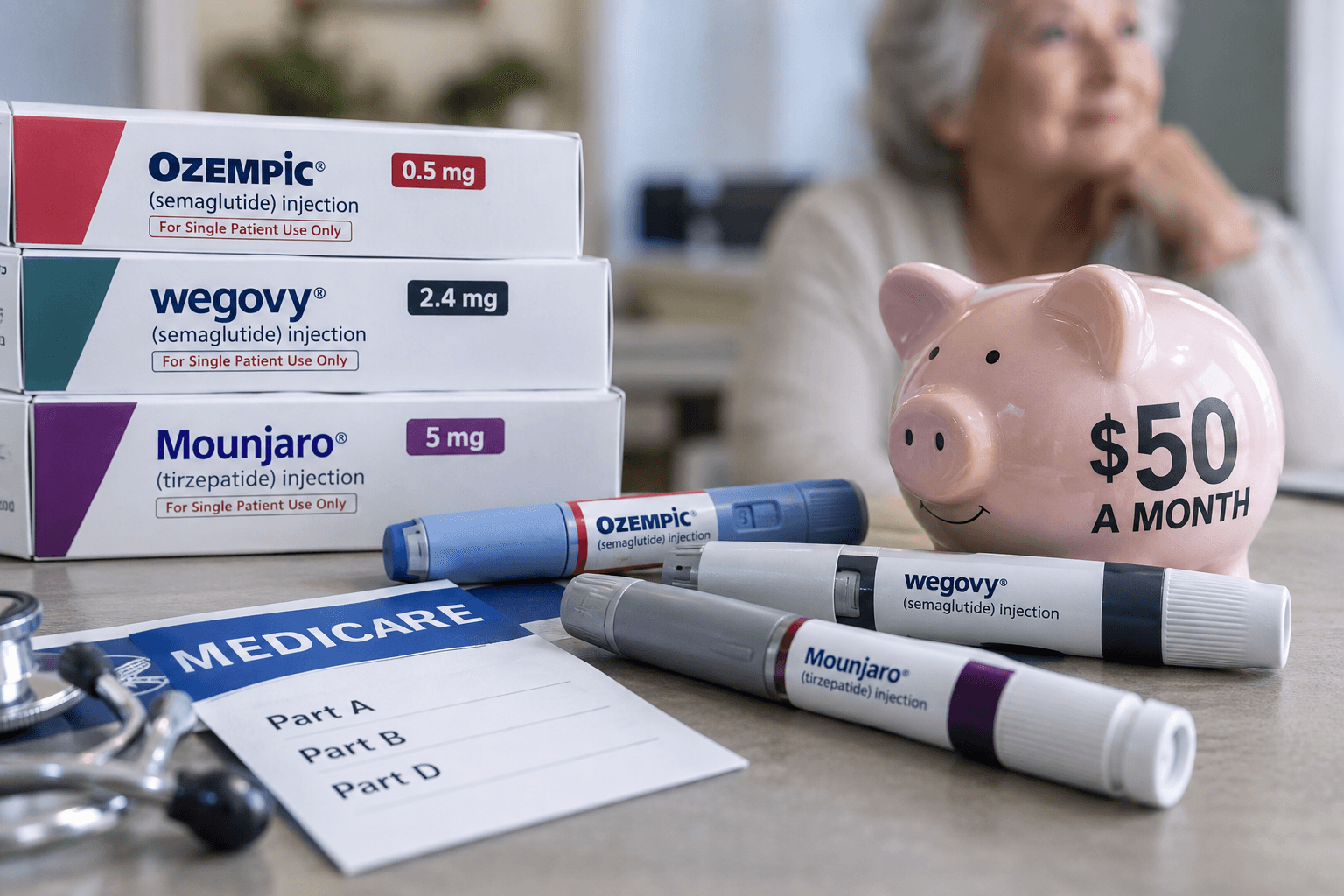
Medicare will offer cheaper GLP-1 weight loss medications to seniors through a new pilot program, covering drugs like Ozempic and Wegovy for $50 a month
A group of weight loss medications on a white background. Photograph: UCG/Universal Images Group/Getty Images
For Kathryn, a 66-year-old retiree from Denver, Colorado, taking a GLP-1 weight loss medication has been a game-changer. She started taking Semaglutide, a type of GLP-1 medication about two years ago and was able to break the cycle of cyclical weight loss and gain that had plagued her for years. At her heaviest, Kathryn weighed 220lbs, but she now weighs 133lbs and has seen significant improvements in her blood pressure and cholesterol levels.
What is the Medicare GLP-1 Bridge program?
However, the cost of Semaglutide, a type of GLP-1 medication, which can be as high as $450 per month, has been a significant burden for Kathryn. She has had to stretch out her dosages to make each order last longer than a month, and has had to put off traveling in retirement due to the expense. But with the launch of a new pilot program on July 1, some Medicare recipients like Kathryn will be able to access GLP-1 weight loss medications for $50 a month.
The Medicare GLP-1 Bridge program will cover three drugs - Foundayo, Wegovy, and Zepbound - and be available to people who have Medicare Part D, an optional extra coverage to lower the cost of prescriptions. To be eligible, participants must have a body mass index of 35 or higher, and cannot have type 2 diabetes, moderate-to-severe sleep apnea, or fatty liver disease.
How will the program affect the healthcare system?
Doctors who treat obesity say the initiative could help millions of older adults who struggle to pay for the drugs or cannot afford to start taking them. Dr. Annie Moore, an internist at CU Health in Denver, notes that the program is a significant step forward, but questions remain about the federal government's administration of the program. "It's a huge social and healthcare experiment to have this volume of people that are going to rely on the CMS website working; the pharmacy side working and the health system side all being able to process these prior authorizations in an efficient, effective way," she said.
Despite the potential benefits of the program, there are concerns about the impact on the healthcare system. Dr. Christopher Weber, an internist in Milwaukee who only sees patients struggling with obesity, notes that the program will be a challenge for clinics, which will have to process a large number of prior authorizations. "If millions more people want to start taking a GLP-1, the clinics are going to be busy," he said.
The Bridge program is slated to run until the end of 2027, prompting providers to raise concerns about what will happen if the government does not extend it. Obesity is a chronic condition, and patients typically regain the weight they lost after stopping a GLP-1. "It's a temporary program; obesity is not a temporary problem," said Dorothea Vafiadis, a senior strategist for healthy aging at the National Council on Aging.
For now, physicians such as Moore and Weber hope the program will allow more patients to start taking a GLP-1. Weber said that he talks with at least five patients each day who could benefit from such a drug but cannot afford it. Carmin, a healthcare worker from Denver, is one such patient. She has been interested in trying a GLP-1 but opted not to because she is saving for retirement. Now, she hopes to use the Bridge program to get back into clothes she was wearing two years ago.
FAQ
- What is the cost of GLP-1 weight loss medications?
- $50 a month through the Medicare GLP-1 Bridge program
- Who is eligible for the program?
- People with Medicare Part D and a body mass index of 35 or higher
Read next
Medicare's GLP-1 Discount Program Leaves Many Patients Behind
A new Medicare pilot program offers discounted GLP-1 medications for weight loss, but millions of patients are excluded due to pre-existing medical conditions, leaving them with unaffordable treatment options.
Medicare's GLP-1 'Bridge' Program May Limit Access to Weight Loss Drugs
Medicare's new 'Bridge' program aims to make GLP-1 weight loss medications more affordable, but its complex eligibility criteria and administrative burdens may limit access for patients. The program, which offers discounted access to medications like Wegovy and Zepbound, requires extensive documentation and prior authorizations, which can delay treatment and increase staff workload.
Medicare to Cover Weight Loss Drugs for $50 a Month
Medicare to cover weight loss drugs like Wegovy and Zepbound for $50 a month under a new pilot program, a significant shift for the healthcare system. The program aims to increase accessibility for older Americans struggling with obesity.
Insurers Struggle with Soaring GLP-1 Drug Costs, Seek to Wean Patients Off
With list prices of roughly $1,000 a month, public and private payers are struggling to keep up with ballooning demand for GLP-1 weight loss drugs, leading some to restrict coverage or explore 'deprescription' to taper patients off the medication.
Trump Administration Creates Temporary Medicare Program for Obesity Drugs
A new government program will make weight loss drugs available to adults 65 and older in Medicare for the first time next month, despite a law prohibiting Medicare from paying for obesity drugs. The program is supposed to be temporary, but may be difficult to end.