Ozempic-Like Drugs May Boost Sperm Quality, But Scientists Want Proof
Scientists are testing whether GLP-1 drugs such as Ozempic can improve sperm quality and testosterone levels in men. A study of 108 men with obesity and/or type 2 diabetes, published in Biomedicines, found that sperm concentrations rose significantly after a year on semaglutide or liraglutide. The share of sperm that could swim forward also climbed, and average testosterone rose about 30 percent. The researchers stress that the study had no control group and cannot show whether the drugs improve a man's chances of conceiving. Larger, controlled trials are needed before any fertility recommendation can be made.
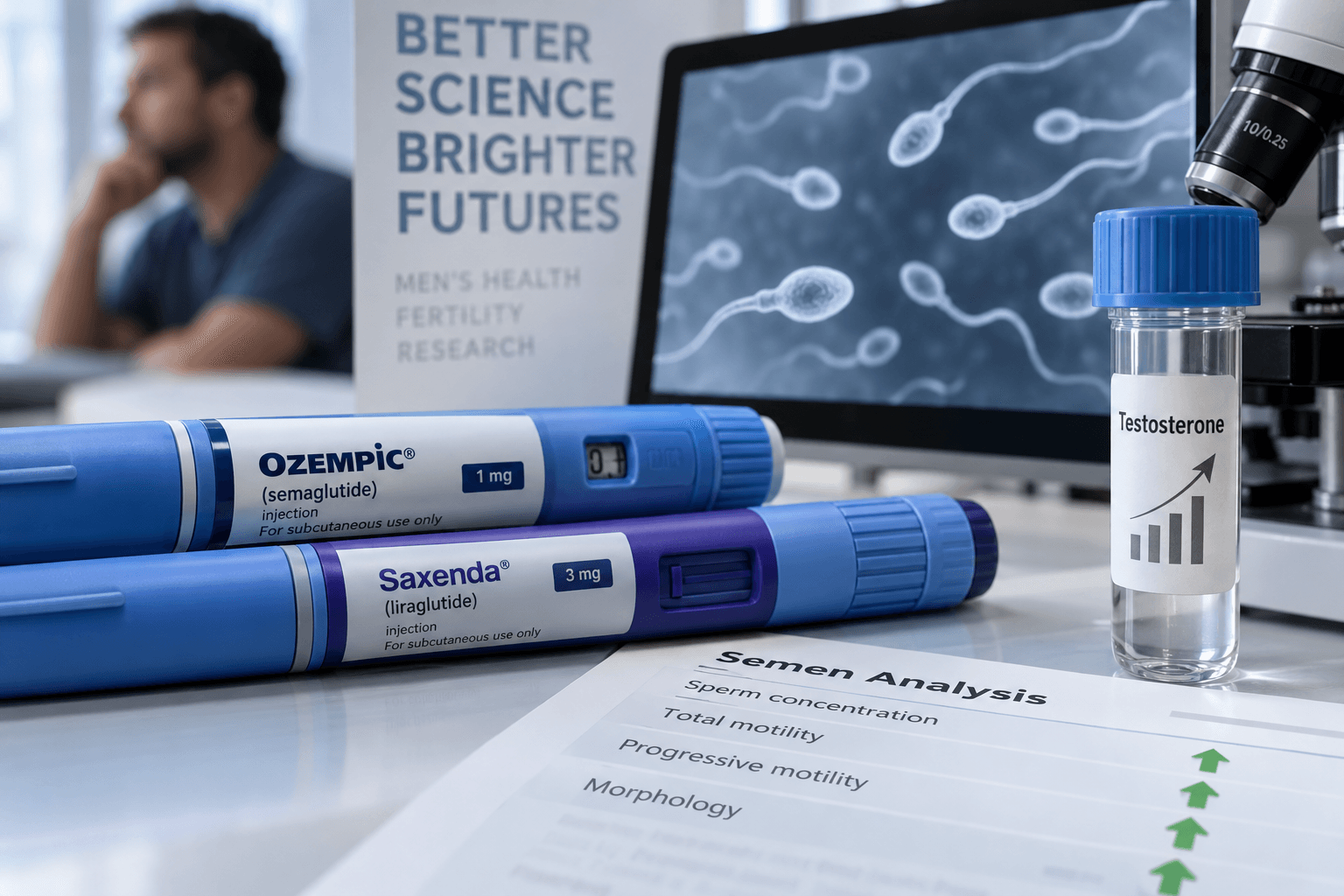
- A study of 108 men with obesity and/or type 2 diabetes links semaglutide and liraglutide to higher sperm concentration after one year.
- Normally shaped sperm rose from just over 3 percent to about 4.5 percent.
- The share of sperm able to swim forward increased from 23 percent to 38 percent.
- Average testosterone levels rose about 30 percent, while estradiol levels fell.
- The study had no control group and no fertility history data, so it cannot show improved chances of conceiving.
- A 2025 Slovenia trial of 13 men reported similar sperm and testosterone gains, but it was not placebo-controlled.
- Researchers say larger, blinded, placebo-controlled trials are needed before recommending these drugs for fertility.
A new study of 108 men with obesity and/or type 2 diabetes links semaglutide (Ozempic) and liraglutide (Victoza) to higher sperm concentration and better sperm shape and movement after a year. Researchers say the study lacks a control group and fertility data, so it does not prove the drugs improve fertility.
Ozempic-like drugs may do more than curb appetite and blood sugar. A new study suggests they could also improve sperm quality and raise testosterone in men. The findings are promising, but the researchers say they are far from proof.
The study followed 108 men with obesity and/or type 2 diabetes. It was published in Biomedicines. Researchers found that semaglutide, the active ingredient in Ozempic, and liraglutide, sold under the brand name Victoza, were linked to significant increases in sperm concentration after a year of treatment.
Can Ozempic-like drugs improve sperm quality?
The numbers moved in the right direction. Before treatment, just over 3 percent of sperm sampled had a normal shape. After 12 months, that figure rose to about 4.5 percent. The percentage of sperm that could swim forward jumped from 23 percent to 38 percent. Sperm do not need to be perfectly shaped to fertilize an egg, but both measures are considered useful markers of quality and function.
"To our knowledge," the study authors write, "this is among the larger prospective series reporting semen outcomes over a full year of GLP-1 [receptor agonist] exposure." That is a notable claim, though the sample remains modest.
Does weight loss explain the testosterone increase?
Hormones showed a striking change. After starting the drugs, average testosterone levels increased by about 30 percent, and estradiol levels fell. Weight loss could explain part of that shift. Some recent studies have found that visceral fat may be a bigger driver of low testosterone than aging.
The data did not fully support that link, however. After accounting for factors including age and diabetes status, a change in body mass index did not line up with sperm concentration. The researchers suggest BMI may not be a reliable measure of visceral fat, which could explain the gap.
That leaves open the possibility that the drugs act directly on the testes. The study authors acknowledge that their data cannot settle the question. "Whether GLP-1 [receptor agonists] also act directly on the testis cannot be determined from our data," they admit. Still, the biology offers clues. Scientists have identified functional GLP-1 receptors on human sperm cells. In mouse models of obesity, early evidence suggests the drugs can protect the testes from damage. One theory is that the medications reduce inflammation or oxidative stress in the testes, where sperm and testosterone are both produced.
Is there proof that GLP-1 drugs improve fertility?
The study has a major limitation. It included no control group and no information on participants' fertility history. As a result, it is unknown whether the drugs improved any man's chances of conceiving. Larger, controlled clinical trials would be needed to answer that question.
Earlier research points in a similar direction. In 2025, a small randomized trial in Slovenia studied 13 men taking semaglutide for obesity, type 2 diabetes and low testosterone. The percentage of normally shaped sperm doubled, and testosterone levels increased. That trial was not placebo-controlled, which weakens its conclusions.
The authors of the 2025 study returned this year with a commentary in Andrology. They argued that sperm production depends on healthy metabolic support from cells in the testes, which rely on insulin-sensitive glucose uptake. Because GLP-1 drugs are designed to improve blood sugar balance, they may affect insulin sensitivity in ways that help sperm production. In their view, the medicine could potentially restore healthy sperm production.
Even so, the commentary urges caution. Its authors wrote that "the effects of GLP-1-based therapies on semen parameters remain uncertain, with currently very limited data." They added that "these findings are preliminary and require confirmation in larger, blinded, placebo-controlled trials with appropriate fertility-preserving comparators.""
The 2026 study authors reached a similar conclusion. Their work suggests that GLP-1 receptor agonist therapy may offer cardiometabolic benefits alongside favorable changes in semen and androgen measures in men with obesity-related metabolic dysfunction. However, they stated that the study "does not justify recommending GLP-1 receptor agonists specifically as a first-line fertility intervention."
For now, the sperm data is intriguing but incomplete. Researchers still do not fully understand how these drugs work throughout the body, let alone what they might do to fertility. Time will tell.
FAQ
- Do Ozempic-like drugs improve sperm quality?
- The study linked semaglutide and liraglutide to higher sperm concentration, a larger share of normally shaped sperm, and more sperm that could swim forward after a year of treatment. The researchers say the findings need confirmation in larger controlled trials.
- Does the study prove GLP-1 drugs improve fertility?
- No. The study had no control group and no information on participants' fertility history, so it is unknown whether the drugs improved any man's chances of conceiving.
Read next
GLP-1 Medications Show Promise in Treating Obesity and Improving Fertility
Research on GLP-1 medications has yielded promising results in treating obesity and improving fertility in men with low testosterone. A study found that GLP-1s may improve testosterone levels and sperm quality, while another study showed a 310-fold increase in GLP-1 prescriptions for children with obesity.
Semaglutide and Fewer Asthma Attacks: What the New Data Shows
A large real-world study presented at the ERS Congress in Barcelona found that people with asthma who started semaglutide, sold as Ozempic and Wegovy, had nearly 40% fewer asthma attacks than similar patients on a different diabetes medication. Researchers also reported lower COPD flare-ups and a possible link to fewer psychiatric hospitalizations. The findings are observational, and the researchers say they should not change how GLP-1 drugs are prescribed until clinical trials confirm them.
When Weight-Loss Drugs Don't Work: The Struggle for Answers
For some people, the highly touted GLP-1 weight-loss medications, such as Ozempic and Wegovy, don't deliver the promised results. Researchers are working to understand why, as patients face disappointment, shame, and significant financial burdens.
Lilly Data Puts Orforglipron and Tirzepatide Ahead of Semaglutide
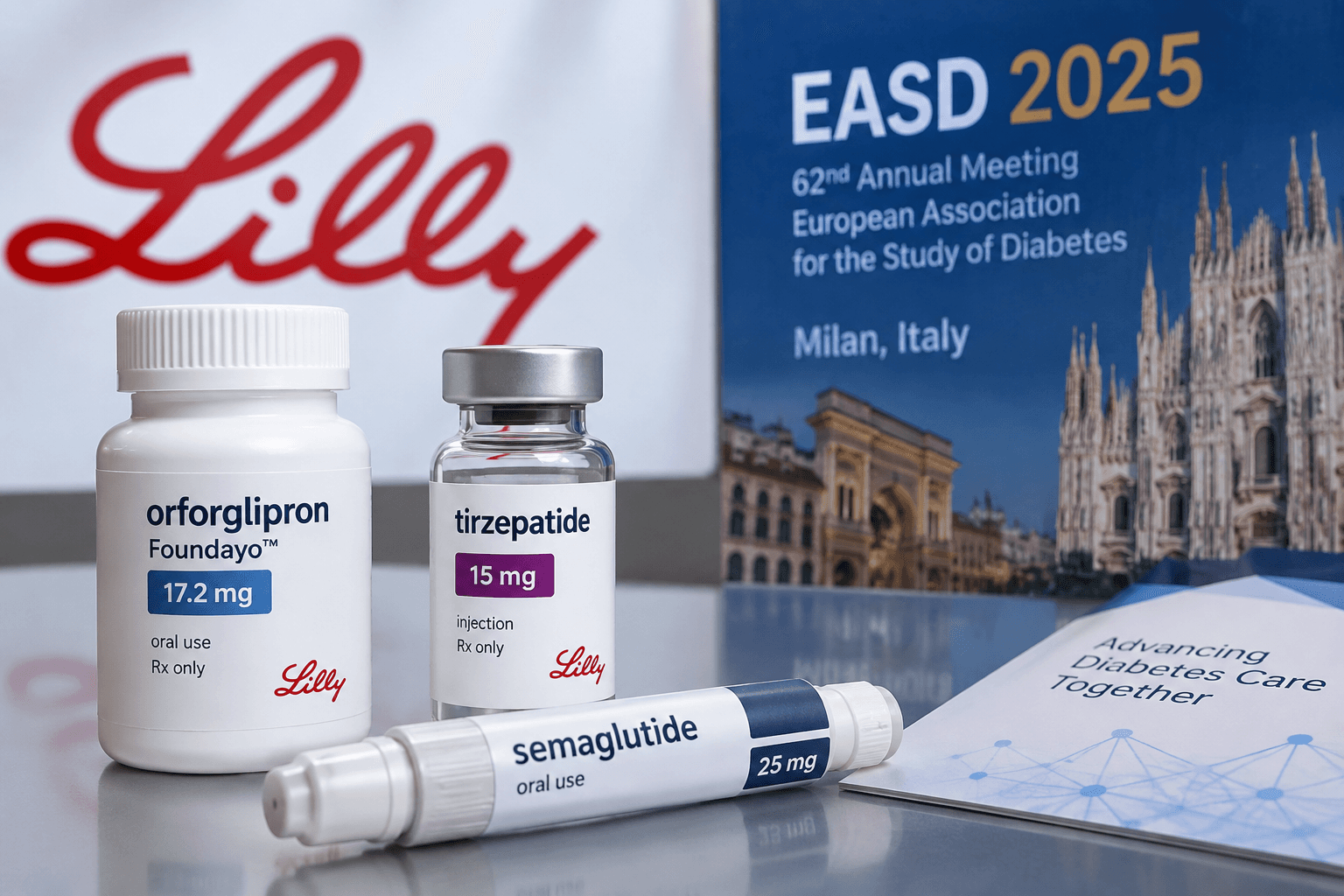
Eli Lilly announced two indirect treatment comparisons showing its drugs outperform semaglutide on weight loss and blood sugar control. Neither result comes from a head-to-head trial. Orforglipron (Foundayo) 17.2 mg produced 1.5% greater weight loss and 0.3% greater A1C reduction than oral semaglutide 25 mg at 52 weeks in adults with type 2 diabetes. Tirzepatide 15 mg beat semaglutide 7.2 mg by 4.5% on body weight at 72 weeks, but that gap was not statistically significant under the efficacy estimand. The analyses were presented at the 62nd Annual Meeting of the European Association for the Study of Diabetes in Milan, Italy. The release did not include safety data for the indirect comparisons.

Low T in Army Men, GLP-1 Blood Pressure Data and Retatrutide Side Effects Make the News
A new round of health research points to a wide range of hormone and metabolic findings. Roughly a quarter of active-duty U.S. Army men had a morning testosterone level under 300 ng/dL, a common cutoff for low testosterone. A CDC report found nearly half of American women ages 40 to 60 reported menopausal symptoms in 2025, and 15.6% of them took prescription medication for those symptoms. Separate studies linked GLP-1 drugs to blood pressure drops and early anti-aging signals. Novo Nordisk reported weight-loss results in women, and Walmart said it will cover over 250 prescription drugs, including some GLP-1 drugs for diabetes, for employees in 2027. An analysis of Reddit posts also cataloged side effects reported by users of the unapproved weight-loss drug retatrutide.